

Recovery from a mental health condition rarely happens all at once. A person might need round-the-clock support during a crisis, then only several hours of therapy each day, followed by a supportive place to ease back into greater independence. The mental health continuum of care connects each of those stages, so no one is left without support when one program ends.
Connor C., a New Roads graduate, described what that kind of connected care meant for him:
“I have nothing but positive things to say about New Roads. A program that offers a step down to independent apartment living with 24-hour staff oversight is truly unique. New Roads helped me to succeed where I have previously failed in other programs.”
Connor’s story shows what’s possible when treatment adjusts as a person grows. Below, we explain how the continuum works, what each level of care looks like, and how to know where to begin for yourself or someone you love.
What Is a Mental Health Continuum of Care?
A mental health continuum of care is a connected range of treatment programs that differ in intensity. At one end is 24-hour residential care. At the other end is a few hours of outpatient therapy each week. In between are daytime programs and transitional living options that help a person bridge the gap as they step down from higher levels of treatment.
The goal is to match care to what a person needs in the moment, then adjust as those needs change. Someone in crisis may start with a round-the-clock structure. As they stabilize, they can move to less intensive care without losing the progress they’ve made.
Continuum care through one facility is intentionally different from fragmented care, where each treatment program operates on its own. In a fragmented system, a person may finish treatment and wait weeks for their next appointment, or start over with a brand-new team that doesn’t know their history. With New Roads, the same treatment foundation and history move with clients from one level of care to the next, so no one has to start over.
Clinicians often use standardized tools to guide decisions surrounding care placement and transitions. One of the most widely used is the Level of Care Utilization System (LOCUS), developed by the American Association for Community Psychiatry. It helps providers recommend an appropriate level of care based on factors like safety, daily functioning, and available support.
Levels of Care Along the Continuum
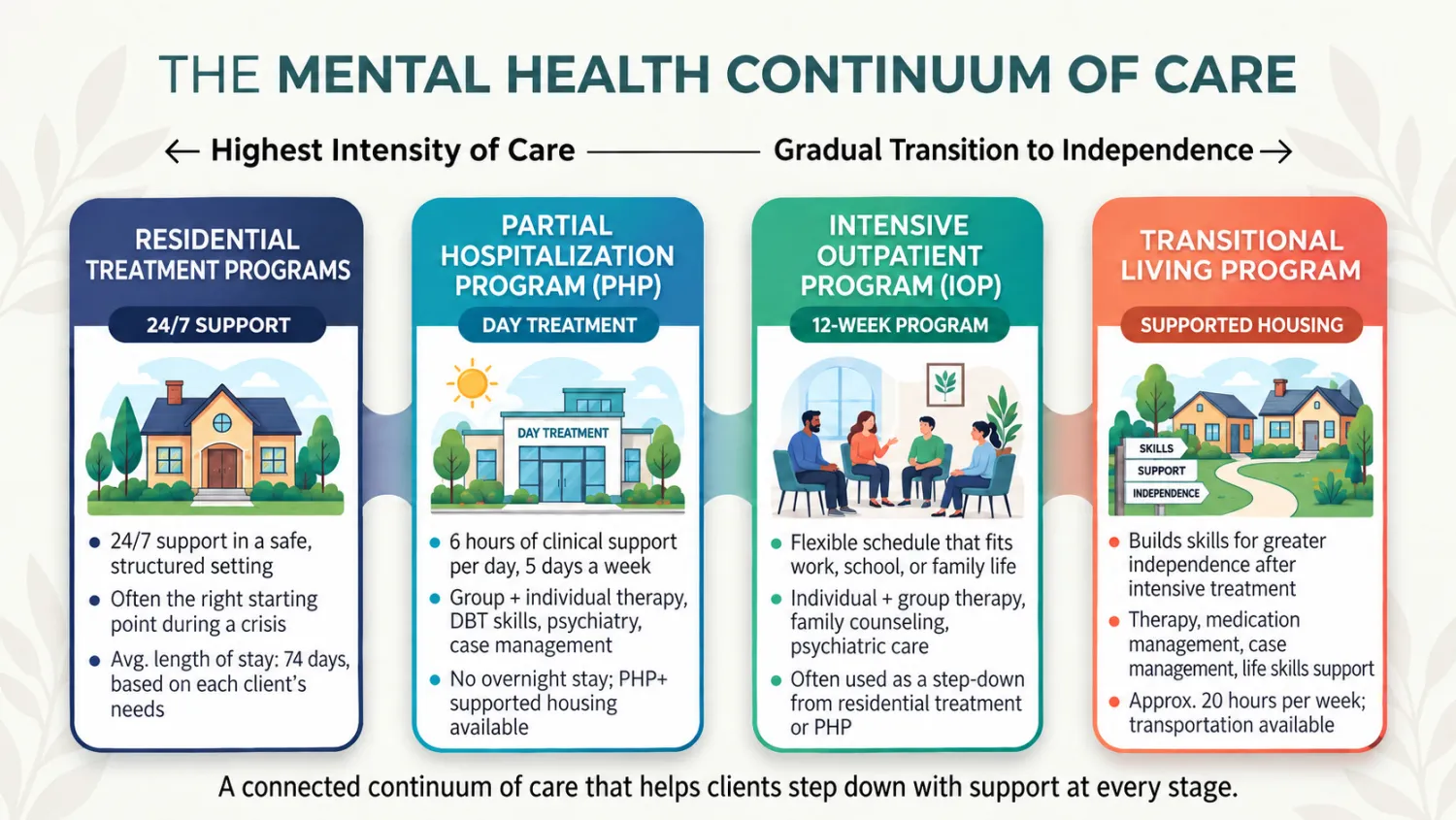
At New Roads, we offer different levels of care to support clients at every stage of their recovery. Each comes with its own balance of structure and independence. Here’s how they all fit together, from most to least intensive:

Residential Treatment Programs
Residential treatment provides 24/7 support in a safe, structured setting. It’s often the right starting point for someone after a recent crisis or someone whose symptoms make daily life unmanageable. At our Provo campus, we use a subacute psychiatric model, which allows us to care for clients with complex conditions that many other programs can’t or won’t treat. Our Women’s Road to Healing (WRTH) program specializes in treating Borderline Personality Disorder (BPD) with Dialectical Behavioral Therapy (DBT). For men seeking treatment, our New Road to Healing (NRTH) program helps them through conditions like schizophrenia and bipolar disorder.
Typical Program Duration: Average residential length of stay (LOS) of 74 days, but timelines are ultimately based on a client’s needs, safety, progress, and at-home support

Partial Hospitalization Program (PHP)
PHP, also called day treatment, offers intensive clinical care without an overnight stay. It’s ideal for clients transitioning out of residential care or those who have tried outpatient therapy but need more support. The schedule includes group and individual therapy, DBT skills groups, psychiatric services, and case management. Clients who need more structure in the evenings may choose our PHP+ supported housing option and live close by to staff.
Typical Program Duration: 6 hours of daily comprehensive clinical support, 5 days a week
Intensive Outpatient Program (IOP)
Our 12-week IOP gives clients more freedom while keeping consistent therapeutic support in place. It combines individual therapy, group therapy, family counseling, and psychiatric care around a person’s work, school, or family life. Many clients join IOP as a step down from residential treatment or PHP. Our outpatient treatment program—along with other treatment programs at New Roads—supports clients with OCD, anxiety, suicidal ideation, bipolar disorder, BPD, and other complex mental health conditions.
Typical Program Duration: 12-week program involving individual and group therapy, plus family counseling and workshops

Transitional Living Program
Transitional living helps adults build the skills to live independently after more intensive treatment. Clients still receive personalized care and support, including therapy, medication management, case management, and life skills development. Supported housing gives clients a stable place to practice those skills with staff nearby. New Roads also offers transportation to our main care facility for those who need it.
Typical Program Duration: Approximately 20 hours per week of clinical and group therapy sessions
Why Continuity Matters in Recovery

The weeks after intensive treatment are an especially important part of recovery. Someone may leave treatment feeling stronger and more prepared, but they’re also stepping back into the routines, stressors, and responsibilities that may have felt overwhelming before. Having steady, uninterrupted support during this transition makes it easier to stay grounded and keep moving forward.
Research points to the value of staying connected during this time. Organizations like the National Committee for Quality Assurance track whether people receive outpatient follow-up within seven days of a psychiatric hospital discharge, because that early contact is considered a key part of safe recovery. In a 2020 study of nearly 140,000 Medicaid-insured youth, those who had a follow-up visit within a week of leaving the hospital had a lower risk of suicide over the next six months.
The relationship someone has with their care team matters, too. A 2023 systematic review in BMC Psychiatry found that people with serious mental health conditions who kept consistent relationships with their providers may have better outcomes, including fewer emergency department visits and a better quality of life.
At New Roads, continuity also means clients don’t have to feel like they’re starting over every time their level of care changes. For example, DBT skills introduced in residential treatment continue into PHP, IOP, and transitional living programs, giving clients a familiar foundation they can keep using as they take the next step.
Knowing Where to Start for Yourself or a Loved One
It’s natural to wonder which level of care is the right fit for your situation. A few questions can help you think it through before you talk with a professional:
- Safety: Are there current concerns about self-harm, suicidal thoughts, or the ability to stay safe at home?
- Daily functioning: Is it possible to keep up with work, school, sleep, and basic routines right now?
- Treatment history: Has outpatient therapy been tried yet, and has it felt like enough support?
- Support at home: Is there a stable, supportive living environment, or would added structure help with recovery and accountability?
- Insurance coverage: Which levels of care does your plan cover, and is New Roads in-network with your plan?
You don’t need to have every question answered before reaching out. Our assessment helps you understand what kind of support may be the best fit by looking at the full picture of a person’s needs. At New Roads, our admissions team will walk you through the process, answer your questions, and help you find a level of care that feels right for you or your loved one.
If you or someone you love is in immediate danger, call or text 988 or go to the nearest emergency room.
Addressing Questions About the Mental Health Continuum of Care
How long does someone stay at each level of care?
It depends on the person. Length of stay is based on progress, symptoms, and treatment goals rather than a fixed timeline. Some programs have a set structure, like our 12-week IOP at New Roads, but the care team regularly reviews each client’s plan to decide when a transition makes sense.
Who decides which level of care is right for me?
The decision starts with a clinical assessment and a conversation about what your needs are. Your care team may look at things like safety, how you’re managing day-to-day, your treatment history, and the support you have at home. Some providers also use tools like LOCUS to help guide their recommendations. Just as importantly, your own goals, preferences, and comfort level are part of the conversation.
Does insurance cover different levels of care?
Many insurance plans cover several levels of mental health care, though benefits vary by plan. New Roads is in-network with most major insurance providers, including UnitedHealthcare, Blue Cross Blue Shield, Aetna, and Cigna. Our admissions team can verify your benefits and explain what your plan covers before treatment begins.
What happens after residential treatment ends?
Most clients step down to a less intensive program rather than going straight home without any further support. At New Roads, that might mean:
- A Partial Hospitalization Program (PHP)
- A PHP+ Supported Housing Option
- An Intensive Outpatient Program (IOP)
- A Transitional Living Program
Our care team plans each transition ahead of time, so each client feels prepared, supported, and able to carry their progress into the next stage of care.
Can someone step back up to a higher level of care?
Yes. Needs can change over time, and that’s completely normal. If symptoms return or everyday life begins to feel harder, our care team may recommend a little more support for a while. Moving to a higher level of care can help someone feel steadier and continue building on the progress they’ve already made.
Can families stay involved throughout treatment?
In most cases, yes, with the client’s consent. Family involvement can look like family counseling, workshops, updates from the care team, or help planning for your loved one’s next step. Many clients come to New Roads through concerned family members, and we welcome their support throughout the recovery process.
Does the continuum of care include support for co-occurring substance use?
Yes. According to a 2024 survey by the Substance Abuse and Mental Health Services Administration (SAMHSA), approximately 21.2 million adults had a co-occurring mental health condition and substance use disorder. That’s why it helps to have one team that can address both. We offer dual diagnosis care across our programs at New Roads, addressing substance use alongside conditions like BPD, bipolar disorder, and PTSD.
A Full Continuum of Care at New Roads

New Roads Behavioral Health is a nonprofit treatment center built on one belief: Every person deserves a chance to live a meaningful life. Our continuum of care spans residential treatment at our Provo campus and outpatient programs at our Cottonwood Heights center, so clients can move through treatment with a team that already knows and cares about them.
We support people with complex mental health needs that many other programs may not be equipped to treat, with DBT integrated into every level of care. As an in-network provider with most major insurance companies, we also work to make treatment more accessible for clients and families.
Wherever you or your loved one is starting, we’re here to make the next step feel possible. Our admissions team can talk through your options, verify insurance, and help you find the level of care that feels like the best fit.
At New Roads, we hold sincere hope and the fundamental belief that all clients can get better.