
What is NPD?
It’s all fun and games to call yourself ‘narcissistic’ when your behaviors are not inherently harmful. The normalization of this term in movies, books, and popular culture has made it almost impossible to distinguish between real-life examples of narcissistic personality disorder or NPD, with many people labeling others’ one-off actions as covertly narcissistic.
Narcissistic personality disorder is a mental disorder that involves a pattern of self-centered, arrogant thinking and behavior, a lack of empathy and consideration for other people, and an excessive need for admiration.
Others often describe people with NPD as cocky, manipulative, selfish, patronizing, and demanding. This way of thinking and behaving surfaces in every area of the narcissist’s life: from work and friendships to family and romantic relationships.
If you’re dealing with someone in your life, whether that be a friend, family member, or yourself, who you suspect has this complex disorder, it helps to first consider their actions at face value.
Are they simply making poor decisions that reflect a normal sense of self-importance? Or, are they putting themselves and others at risk by indulging in the version of themselves that’s anything but real?
While diagnosing narcissistic personality disorder can be difficult, you can start to recognize the signs as they reveal themselves. Then, with the help of trained clinical professionals, you or your loved one can get the impartial but caring treatment you deserve.
Narcissistic Traits
Most narcissistic traits start small. They appear in subtle actions that others might sweep under the rug, with traits like repeated sensitivity to criticism and emotional defensiveness.
NPD can start as early as childhood. This is why it’s best to understand how, when, and why these common traits appear.
If a child (and their parents) can recognize that there is a self-esteem issue at hand, the proper treatment can be given, and the impending life-long effects minimized.
Narcissistic personality disorder affects everyone, from your mom to your favorite coworker. Signs may just be hidden under snide remarks and comments like “that’s just who they are.” Look out for these common NPD traits to know if a person is exhibiting classic narcissistic behavior:
- False sense of reality (this includes their self-image/importance)
- Heightened sensitivity to criticism or failure
- Emotional guardedness or detachment
- An inflated sense of entitlement (Even Early On)
- Limited self-reflection under stress
Signs of Narcissistic Personality Disorder

Because narcissistic personality disorder is a mental health disorder, it deserves the same careful care that other life-altering disorders like borderline personality disorder require. It may feel overblown to recognize the real symptoms of NPD, as it shares traits with everyday qualities that people possess: self-important thoughts, a need for attention, and entitlement.
The difference between these qualities is extremity. For those who show signs of the DSM-5’s (the 5th edition of the Diagnostic and Statistical Manual) understanding of narcissistic personality disorder, these traits aren’t just passing thoughts, but the foundation of a fake reality filled with grandiose ideals.
A person exhibiting signs of NPD, as defined by the American Psychiatric Association (DSM-5-TR criteria), may:
- Exaggerate achievements or recognitions
- Preoccupy themselves with fantasy over real-life enjoyment
- Believe and use words that imply they’re ‘better’ than others
- Not respond well to those who don’t fit their behavior criteria
- Display excessive greed and jealousy
A telltale sign that a person is struggling with any type of NPD is rigidity. Whether that’s in action, in conversation, or in passing, the way they respond to change will tell you exactly where their self-image lies. And because narcissism revolves around a deep fear of being “exposed” (often case of real humans with flaws), any wrong move is a cut to their ego.
Different Types of Narcissists
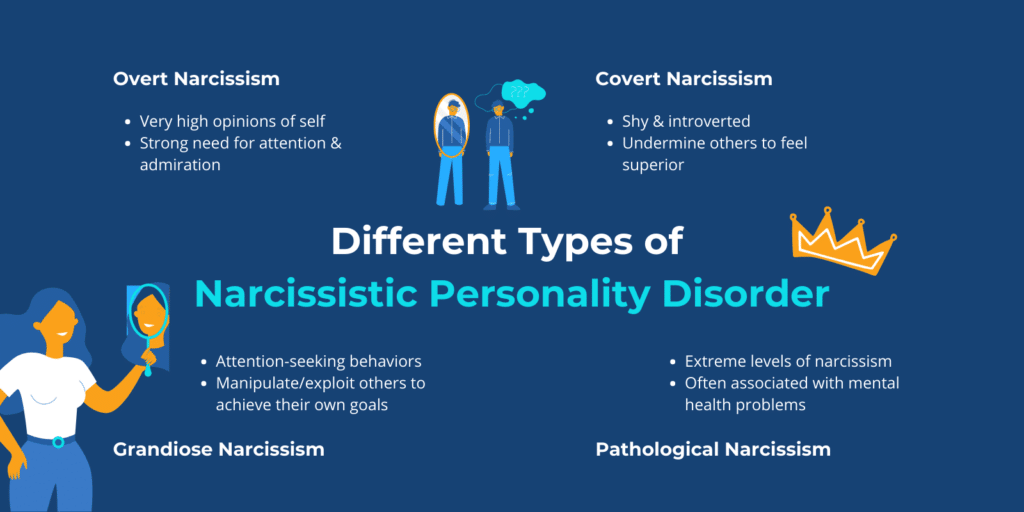
The different forms of maladaptive narcissism include:
Adaptive narcissism is when a person with this disorder leans into positive traits—such as self-sufficiency and confidence—that can be healthy. They may help someone set high ambitions at work, for example, or enjoy satisfying relationships without being overdependent on a partner. But because narcissism is innately self-important, they may not be able to process their contribution in a healthy way.
Maladaptive narcissism, on the other hand, is underlined by the common toxic traits, such as a sense of entitlement and a willingness to exploit others. This type of narcissism is ‘maladaptive’ because it places a person’s overblown, fantasy image of themself over reality, in turn fueling those classic negative traits.
Overt or grandiose narcissism
Overt narcissists tend to be extroverted but also uncooperative, selfish, and overbearing. Their exaggerated self-image and high self-esteem allow them to be confident and assertive. However, they’re also likely to overestimate their own emotional intelligence.
Covert or vulnerable narcissism
It’s common to imagine all narcissists as dominant and overwhelming in social situations. However, covert narcissists are introverted. They tend to be extremely sensitive to criticism and suffer from low self-esteem. They can be defensive and passive-aggressive, but they are less likely to overestimate their emotional abilities than overt narcissists.
Communal narcissism
Communal narcissists tend to view themselves as altruistic and claim to care deeply about fairness. They present themselves to others as supportive and selfless. However, their behavior is motivated by a desire for social power and a sense of superiority or entitlement. Because of this, their actions don’t always match their beliefs.
Antagonistic narcissism
In contrast with communal narcissists, antagonistic narcissists take a highly competitive approach to social interactions. They often exhibit zero-sum thinking, believing that every situation has a “loser” and “winner.” This view of the world leads them to be aggressive and hostile. They may be quick to disparage others and slow or unwilling to forgive.
Malignant narcissism
Malignant narcissism can be a more destructive form of the personality disorder. In addition to the typical signs of narcissism, a malignant narcissist might be aggressive, paranoid, or sadistic—taking joy in other people’s pain. They tend to display antisocial behavior, disregarding others’ rights and safety.
Dealing With A Narcissist In Your Life (Even If That’s You)

Acknowledging that narcissism is at play can be difficult. When it comes to others, you want to believe that that person isn’t as self-absorbed as they seem, that it’s just an act they put on for attention. And when you’re actually faced with the reality of their disorder head-on, you may still not want to believe it.
The same goes for yourself. While the stigma against mental health disorders, especially NPD, is rampant, it doesn’t have to be something to be ashamed of. In fact, treatment centers (like New Roads) offer innovative, client-focused solutions that can mark the start of a new, fulfilling journey toward self-acceptance.
Like most mental health issues, NPD is not one-size-fits-all. The way you handle the narcissist in your life will largely depend on their symptoms. Some might be socially isolated and harder to break through, while others might be lost in a haze of narcissistic injury.
For the best results when approaching the narcissist in your life, keep these psychiatrist-approved mitigation methods in mind:
If It’s Someone Else
If you’re trying to find a way to start the ever-dreaded conversation about your loved one’s behavior, first remember to take it slow. Approach them in increments with calm, concerned verbiage. That way, they understand, even from their isolated headspace, that you care about them and want to see them better.
You don’t necessarily have to tell them to seek treatment. In fact, we wouldn’t recommend it. Remember that you need to set health boundaries with them before, during, or after these conversations occur so that they know where you will not engage.
They don’t see you. They don’t hear you. They don’t recognize you as someone who exists outside of their own needs. Because of this, narcissists regularly violate the boundaries of others. What’s more, they do so with an absolute sense of entitlement.
If It’s Yourself
Recognizing narcissistic personality disorder symptoms in yourself can be scary. You might be quick to ignore them, deeming that volatile inner voice as a piece of your identity rather than a real mental health symptom. Mental disorders, such as narcissistic personality disorder, can be the toughest to admit or deal with when you’re the one who’s struggling.
Luckily, there are licensed mental health professionals willing to meet you where you are, judgment-free, and with available tools to help you cope with whatever titular trait might be holding you back: the need for excessive adoration, emotional regulation issues, or a negative sense of self.
Take your self-preoccupation where you will be truly heard, and soon enough, you’ll be able to combat these impulses as they appear.
For help diagnosing yourself or a loved one, contact us for a confidential assessment today.
Get a Different Kind of Narcissistic Personality Disorder Treatment at New Roads

NPD is challenging to treat. Its nuanced interpersonal difficulties make it that much harder to even diagnose. Even so, there is a chance you can (and will) find solutions, whether that be traditional talk therapy to address early adulthood or childhood triggers, or a deeper method of CBT that involves acknowledging personal examples of healthy narcissism.
Sometimes, NPD overlaps with other disorders such as antisocial personality disorder. This is because the high-functioning emotional dysregulation associated with NPD can trigger other symptoms: depressive episodes, mania, and anxiety.
At New Roads Behavioral Health, we focus on establishing each patient a personalized treatment plan that meets their needs. Every person struggling with the reality of NPD has personality traits that dominate their mental health condition, so yielding a treatment method that actually does the work will depend on individual goals.
We’re concerned about your mental health, but also respect your privacy. At New Roads, our commitment to confidentiality is just as important as our mental health services.
Here’s a look at our specialized behavioral health programs for those with pathological narcissistic traits seeking a clear way forward:
Evidence-Based Psychotherapy
Think of this treatment sector as a big ‘reality check.’ Narcissists are forced, through recalling key life events and or conversations with others, to recognize the patterns of their thoughts and behaviors. Here, they can use these memories to shape healthier behaviors.
Common evidence-based psychotherapy techniques used by New Roads specialists include:
- Schema Therapy
- Transfer-Focused Therapy
- Mentalization-Based Therapy
- CBT & TBT
- Metacognitive Interpersonal Therapy
EMDR & Trauma-Informed Care
Sometimes NPD occurs as a trauma response. In these cases, it’s best to employ multiple trauma-informed care methods, a popular one at New Roads being EMDR (Eye Movement Desensitization and Reprocessing).
This process involves facing traumatic memories so that the brain can rewire its response mechanisms. With repetition, the patient will no longer experience negative reactions to shame, guilt, or fear associated with these memories.
This may help them shed the negative self-talk commonly associated with NPD, which can be a strong reason so many cannot break the cycle.
Narcissistic Abuse Recovery
On the other side of the spectrum, and often overlooked, are those living with the effects of narcissistic abuse at the hands of another. Although this abuse may not be physical in nature, it impacts the whole-body response survivors have to the actions of their abuser.
Our experienced therapists are proud to provide survivor-focused care for those living with the aftermath of narcissistic abuse. Recovery looks different for everyone, but we tend to start with somatic therapies as well as traditional talk therapy to help survivors better understand their role in these traumatic events.
Ready to move forward, but don’t know where to start? Read more about New Roads and our NPD treatment options in our dedicated frequently asked questions about personality disorder page.